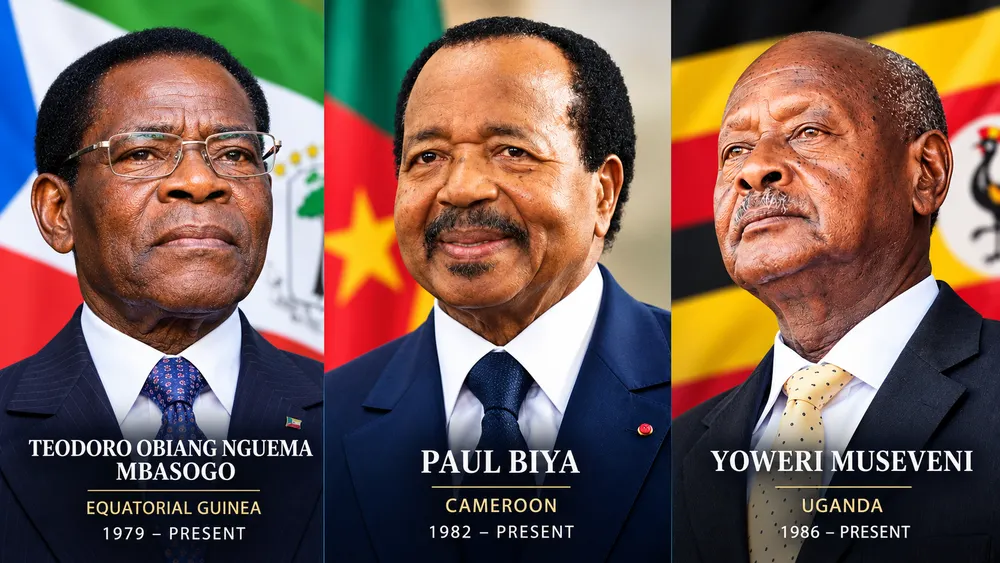
On October 12, 2025, Cameroon's most recent presidential election day, I woke up excited to exercise my right of franchise for the first time as a Cameroonian. I joined almost a thousand others at our polling station. I cast my vote, and so did many others. Biya who acceded office in 1982 won an eighth term at 92, a mandate that runs until he is nearly 100. He is the world's oldest head of state and one of the longest serving nonroyal leaders alive, having ruled for almost 44 years now.
Yoweri Kaguta Museveni, his Ugandan counterpart, is 81. He came to power in January 1986 after his NRA forces overthrew the government of Tito Okello. In elections held this past January, he won a seventh term that runs until 2031. He is over 40 years in power and would be around 86 or 87 and past 45 years in office by the end of that term.
Teodoro Obiang Nguema Mbasogo became leader of Equatorial Guinea in August 1979 after seizing power in a coup against his uncle, Francisco Macías Nguema, and formally became president in 1982. Born in June 1942, he is 84, not the age often assumed once you start rounding a man's rule instead of his birth certificate. He has held power for 47 years now, 3 as head of a ruling council before the presidency existed on paper, and 44 as its formally recognized occupant. If his current term runs its full seven years, he would be about 87 and past half a century in power by the time it ends.
What can be seen here is arithmetic anyone can check. Add it up and the trio have accumulated roughly 131 years of rule between them. That is not merely a long time in office. Set against the countries themselves, it becomes a different kind of number. Cameroon has been independent for about 66 years, and Biya has governed it for 44 of them. Uganda has been independent for about 64 years, and Museveni has governed it for 40. Equatorial Guinea has been independent for about 58 years, and Obiang has held power for 47 of them, which is not a majority of its history so much as nearly all of it. These men have not simply ruled a long time. They have, for stretches of these nations' lives, been functionally indistinguishable from the state itself.
Africa is a young continent governed in places by very old men. Most of its 54 states emerged from colonial rule within living memory, the bulk of them in one compressed wave across the twentieth century. And yet three of its presidents have each individually occupied power for a span approaching the working lifetime of the independent state they lead. That is a crisis, whatever word each of these governments would prefer for it, because a succession crisis does not require an empty chair to already exist. It only requires that nobody can say who sits in it next, or by what process, while the current occupant is still very much alive.
Here is what is easiest to miss while watching the men at the top: Cameroon's median age is about 18, Equatorial Guinea's is 20.9, and Uganda's is close to 17.1. Entire populations who were not alive for the last peaceful transfer of power in any of these three countries are now governed by men in their eighties and nineties who were already in office before those populations were born. That is not an abstract cost. Whatever comes after Biya in Cameroon lands on top of an unresolved Anglophone crisis. That is not a hypothetical cost. It is the bill already sitting on the table, waiting for a date nobody has been told.
None of this is a case for youth or for coups as an automatic corrective, and the region has already run that experiment. Gabon, Mali, and Niger have shown that removing an old man replaces the face at the top without replacing the absence underneath it, a functioning, agreed, and public answer to a simple question. Who governs next, and how do we know. That absence, and why it exists, is worth asking a harder question about than longevity alone can answer.
A nation that cannot say, in advance and out loud, who governs next has not planned a succession. It has delayed a reckoning and called the delay stability.