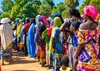
On my way from Akwa yesterday, I observed a queue of buyers at the Boulangerie Saker in Bonaberi. Everyone standing to buy something: gateau, croissant, bread, something made of flour. It was reminiscent of similar queues I have seen at filling stations, people waiting for a crude product: petrol, kerosene, and so on.
This kind of waiting resembles the waiting Cameroonians do as a state. Everybody waiting for something, maybe specific, but from the same source. It could be political reform, a change of policy, poverty alleviation programs, subsidized and improved healthcare. All different, but coming from the same source: the state.
How long have Cameroonians been waiting for the long overdue cabinet reshuffle, the Bamenda ring road, the postponed municipal elections, the appointment of whoever will occupy the newly created role of vice president, the widening of our death trap roads, construction of infrastructure in general?
Cameroon appears to exist in a suspended present, neither moving forward nor collapsing, but with a conspicuous retrogression. The country is standing still in a manner that looks like maintenance rather than accident.
Does that mean politics is absent simply because the country is waiting? No, it is present, but in many ways a condition beneficial to someone, or some people.
The pertinent question is who gains when uncertainty becomes governance itself? There are incentives that sustain this kind of indefinite transition. Power is never formally handed over, and questions are never formally answered. Take, for instance, the unspoken succession question.
It is important to note that this waiting is not pure passivity or victimhood. Cameroonians are not simply paralyzed by it. They have ingeniously adapted to it, built lives, businesses, and families inside the waiting, until they have learned to live as though they no longer care what government has to offer them.
That adaptive resilience is itself, ironically, a quiet enabler of the waiting mechanism, making the wait longer than it should be. If we have evolved to be self reliant inside our waiting, why should the one who makes us wait ever come, once he realizes our waiting has produced its own solution?
According to a Facebook publication by CGTN Africa, Cameroon's National Institute of Statistics (INS) data highlight that youth unemployment and underemployment spikes dramatically, with some parliamentary and policy estimates putting the crisis-level impact or vulnerable youth joblessness as high as 74% among active young demographics.
The Olembe multipurpose sports complex sits stalled. The Bamenda ring road remains a forgotten dream.
Waiting eventually becomes its own answer. A country can spend so long waiting to be told what comes next that the waiting becomes the regime. The emergency was never declared, because the emergency was never meant to end.