
Across Africa, a young voter can believe in democracy without belonging to a political party. They might follow an election on TikTok or X, debate public affairs online, question an official result, and still end up on the streets when formal channels seem unresponsive, wanting democracy even while growing frustrated with how it actually works. That tension is becoming harder to ignore on a continent where the population is getting younger even as many of its political institutions remain dominated by older generations.
Two recent developments illustrate the institutional environment younger Africans are coming of age in. In Tanzania, Vice-President Emmanuel Nchimbi announced his resignation less than a year after taking office. No official reason was given, although Nchimbi had recently attracted criticism within the ruling Chama Cha Mapinduzi after advocating constitutional reform. In Zambia, authorities sealed off and closed the country's top courts on the final day available for the opposition to challenge the results of the August 13 presidential election, citing security concerns. Neither episode is, strictly speaking, a youth story. Their significance lies in what they reveal about the formal institutions through which political power is contested and challenged, and the frustration that can build when those institutions seem unresponsive or hard to reach.
Many younger Africans are increasingly finding political expression beyond those traditional structures. Africa's demographic arithmetic makes the shift consequential. Young people aged 15 to 35 account for roughly 400 million people, or about 35% of the continent's population, according to an ACEPA synthesis of demographic and political data. Yet young Africans remain underrepresented in legislatures and other centres of formal political power.
Africa's youthfulness matters, but demographics alone don't explain the political shift. The more consequential change is how young Africans are participating. Research drawing on Afrobarometer data indicates that young Africans report lower levels of participation than older citizens in several conventional forms of political engagement, including voting, attending community meetings and identifying with political parties. That can easily be mistaken for apathy. It may instead reflect political engagement taking forms traditional institutions were never designed to accommodate.
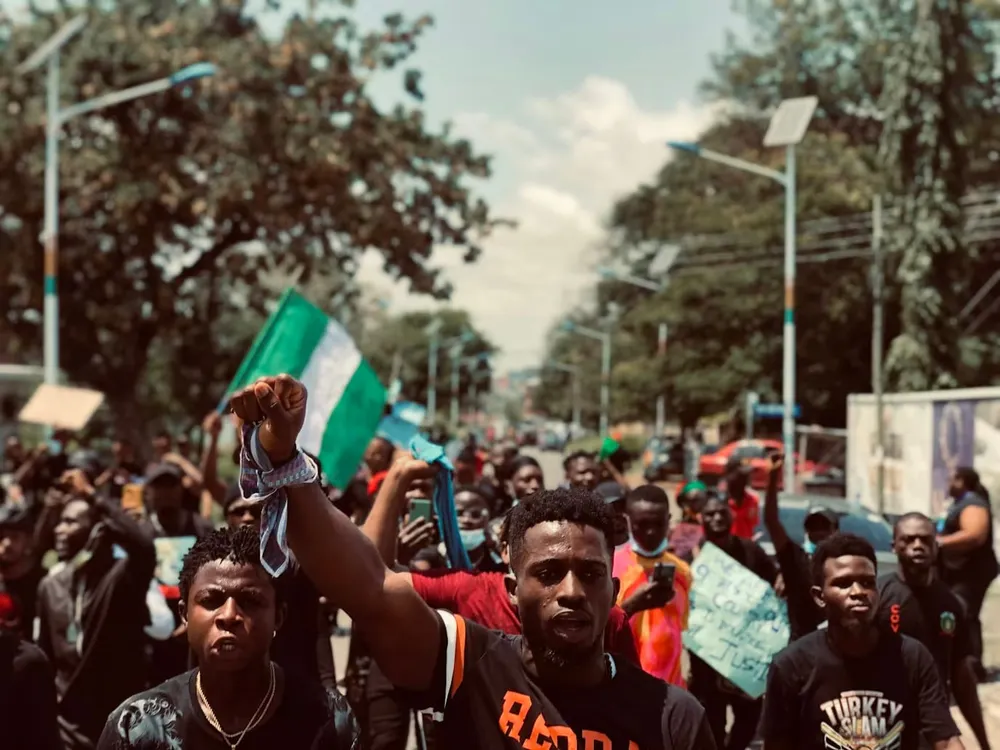
Across the continent, political participation is spilling into spaces established political organisations don't traditionally control. Social-media platforms have become arenas for political debate and mobilisation, while youth-led protests in countries including Kenya have shown how online networks can turn grievances over economic conditions, governance and political exclusion into street mobilisation. Similar youth-led mobilisations, driven by different combinations of economic, political and electoral grievances, have emerged elsewhere, including Nigeria, Uganda, Mozambique and Senegal. The political party, in other words, is no longer the only route into political life.
None of this means young Africans have stopped caring about politics. A young citizen might reject party membership while following politics obsessively. Another might organise an online campaign without ever joining a political organisation, or mobilise around a single grievance without becoming part of any permanent movement. Political participation can increasingly form around an issue, a hashtag, a campaign or a protest, sometimes with little of the organisational structure that traditionally defined political activism.
Research on Tanzania's youth, for example, points to growing use of digital spaces for political engagement, alongside frustration over economic conditions, political accountability and the limits of conventional political participation. The significance isn't that digital activism has replaced established politics, it's that young citizens now have extra ways to organise and communicate, and to push back when conventional avenues fall short.
There's an important distinction, though, between dissatisfaction with how democracy functions and rejection of democracy itself. ACEPA's synthesis of Afrobarometer findings indicates that 64% of African youth prefer democracy to other forms of government, while 80% reject dictatorship and 65% reject military rule. At the same time, frustration with the performance of elected governments remains substantial.
That apparent contradiction may be central to understanding the politics of Africa's younger generation. A young person can be deeply frustrated by an election result and still believe elections matter, can distrust politicians without distrusting democratic government itself, and can protest against an elected government precisely because they believe it failed to live up to the promises that gave it legitimacy in the first place.
In that sense, frustration with democracy may sometimes come precisely from taking democracy seriously. Young citizens may not be turning away from democracy so much as demanding more from it: elections, yes, but credible results; representation, but not merely symbolic inclusion; political voice, and institutions that respond between elections as well as during them.
The difficulty is that the institutions through which democratic participation is traditionally organised have often been slow to adapt. Political parties remain hierarchical organisations where access to candidacy can depend on established networks, money and patronage, and youth representation can become tokenistic when younger people are brought into political structures without gaining any real influence over decisions. The result is a growing mismatch between how institutions expect citizens to participate and how many young citizens actually experience political life.
The traditional political system tends to imagine participation running in a fairly fixed line: you join a party, it puts up a candidate, an election happens, and eventually that translates into a seat in parliament and a role in government. Increasingly, some young citizens experience political participation differently, starting from a network or an online platform, building into a campaign, sometimes growing into a movement, and applying pressure from there rather than working through a party structure at all. These systems can coexist, and most young Africans still engage with conventional politics in some form. But when formal channels appear unresponsive, or when access to them becomes contested, the incentive to organise outside them grows.
The bigger question, then, is not simply whether young people will vote more or join more political parties. It's whether political institutions can accommodate citizens who want to participate differently, and whether governments and parties are willing to treat those forms of participation as legitimate rather than as a threat to be managed.
The young African at the centre of this shift isn't necessarily a revolutionary. They might be a voter questioning a result, or a social-media user with no party affiliation, or a protester who's concluded formal channels have failed, or just someone watching political institutions stay dominated by people decades older than themselves. What connects these experiences isn't hostility to democracy, but a growing impatience with the distance between democratic promises and institutional performance.
Africa's political systems have spent decades learning how to manage parties, elections and conventional opposition. Their harder task now may be learning to recognise political participation when it shows up without a party card, a campaign office, or a seat in parliament. The question is no longer whether Africa's young people will participate in politics. They already are. The question is whether the institutions governing the continent can keep up with how they've chosen to do it.